 Septic Tank Solutions
Septic guides
New council septic strategies in NSW: what changes for your tank and what doesn't
A NSW council's septic strategy is its own plan for approving, inspecting and prioritising systems, not a new law, so your core duties stay the same: council approval to install, a separate council approval to operate, and a system you keep working.
Three NSW councils, one year: what the count tells you
The road a septic strategy travels
Start: state guidance
- 9 April 2025 OLG Council Circular 25-05 announces the Onsite Wastewater Management Guidelines (April 2025), which replace the 1998 "Silver Book" and include a model strategy councils may adapt.
MidCoast
- 9 Feb to 12 Mar 2026 exhibition: 186 submissions
- 29 Apr 2026 Adopted, flat per-system fee kept
Ballina
- August 2026 Council resolved to adopt strategy and Guidelines (Ordinary meeting); 28-day exhibition
Cessnock
- 9 Oct to 6 Nov 2026 exhibition
- Then Consultation concluded, Engagement Summary Report published
- Next Review, then final adoption (no date set)
Sources: Council Circular 25-05, NSW Office of Local Government, MidCoast Council, Your Say Ballina, Together Cessnock
Three NSW councils have taken a new septic strategy to their communities in 2026. MidCoast Council adopted its Healthy Land, Healthy Water strategy at its 29 April meeting. Ballina Shire Council resolved to adopt its updated Onsite Wastewater Management Strategy in August. Cessnock's draft was on public exhibition from 9 October to 6 November 2026. That exhibition has closed, and the final version is still to come.
Two of the three give a plain answer on what changes for owners:
- MidCoast kept its current flat service fee per system rather than move to a fee that varied by property location.
- Cessnock says its draft "does not introduce major changes to existing practice".
Ballina's page describes what its strategy covers rather than what it changes. So both clear answers point the same way: steady, not sweeping.
That is our reading across three council pages, not a forecast for yours. If you live outside these three areas, the pattern still helps, but your own council sets the detail.
What a council septic strategy is, and why councils are rewriting them
Law, guidance, strategy: who sets what in NSW
| Layer | What it is | Example |
|---|---|---|
| Law | Local Government Act 1993 and Local Government (General) Regulation 2021 | Governs Central Coast Council's approval to operate |
| State guidance | OLG Onsite Wastewater Management Guidelines (April 2025), replacing the 1998 Silver Book | A process for approving systems and advice on updating council strategies |
| Council strategy | The council's own plan | Cessnock's draft "outlines how Council manages and regulates on-site wastewater systems", and MidCoast's helps officers prioritise inspections |
Sources: business.gov.au, NSW Office of Local Government, Together Cessnock, MidCoast Council
A council's on-site sewage strategy is its own plan for running its septic program. It covers how the council approves systems, which ones it inspects first and how it spots the risky ones. Cessnock's draft, for example, outlines how Council manages and regulates on-site wastewater systems.
The law sits above the strategy. Central Coast Council's approval to operate is governed by the Local Government Act 1993 and the Local Government (General) Regulation 2021. A strategy works inside that law. It does not replace it.
So why are so many being rewritten at once? The change came from the state. In April 2025 the Office of Local Government's Onsite Wastewater Management Guidelines replaced the 1998 "Silver Book". They give councils a process for approving systems and practical advice on updating their strategies.
The circular that announced them, Council Circular 25-05 as republished on EIN Presswire, says the update includes a new model strategy. Councils "may wish to refer to and/or adapt" it "when next reviewing their strategies", and regular review "is encouraged". A wave of local rewrites is what that invitation looks like on the ground.
Cessnock: submissions closed, final strategy still to come
"does not introduce major changes to existing practice"
Cessnock's Draft On-Site Sewage Management Strategy 2026-2031 covers septic tanks and aerated treatment systems on properties not connected to town sewer. Council says the draft formalises current processes, strengthens best-practice alignment and aligns with the OLG guidelines from 2025.
The project page now reads "Consultation has concluded". An Engagement Summary Report has been published, and the final adopted version is still to come.
Wondering about cost? The page lists "Will the Draft OSSM Strategy increase the cost of managing my on-site sewage system?" among its FAQs. Read Council's own answer there.
What already applies in Cessnock is set out on Council's septic page. The owner is responsible for making sure the system is registered, approved by Council and working safely. Annual fees apply to properties with an on-site system, calculated under Council's Fees and Charges.
MidCoast and Ballina: two strategies, same basic job
Three NSW council strategies side by side
| Council | Where it stands (November 2026) | What the page says it covers | Owner-facing detail on the page |
|---|---|---|---|
| Cessnock | Exhibition closed 6 Nov 2026, in review, final version to come | Septic tanks and aerated treatment systems on properties not connected to town sewer | "does not introduce major changes to existing practice" |
| MidCoast | Adopted 29 Apr 2026 | About 13,000 septic systems | Flat service fee per system kept, and helps officers "identify higher-risk systems earlier" |
| Ballina | Council resolved to adopt at its August 2026 Ordinary meeting, with new Guidelines; the page also lists a 28-day exhibition closing 28 September 2026 | "design, construction, installation, operation and maintenance" | Check Council's page for fees and inspections |
Sources: Together Cessnock, MidCoast Council, Your Say Ballina
MidCoast's strategy covers about 13,000 septic systems. The draft was exhibited from 9 February to 12 March 2026 and drew 186 submissions. Feedback focused on the funding model, the risk framework and perceived duplication with existing servicing.
The outcome owners notice on their bill is that Council kept the flat per-system fee. Behind the scenes, the strategy is meant to help officers prioritise inspections and "identify higher-risk systems earlier".
At its August 2026 Ordinary meeting, Ballina Shire Council resolved to adopt the updated strategy and the Onsite Wastewater Management Guidelines. Its strategy spans "design, construction, installation, operation and maintenance". Ballina's page also lists a 28-day exhibition that closed on 28 September 2026, so check it for the final text.
For inspection timing or fees in either area, go to the council's own page. A strategy is not a fee schedule.
Do I need council approval to operate a septic system?
Which approval do I need?
1. Is the system being installed, or already in the ground?
2. If already installed, do you hold a current approval to operate?
3. Domestic or commercial?
4. Is the property in Central Coast Council's area?
Typical answer
An installed domestic system on the Central Coast whose owner holds an approval to operate needs a renewal, and the renewal fee is set by Central Coast Council (see its listing, checked November 2026).
Fee, checked November 2026: Central Coast Council lists separate 2026-27 fees to apply and to renew, for domestic and commercial systems. See its approval to operate listing on business.gov.au.
The application must show how the system is operated, maintained and serviced, and what happens in a breakdown.
Rule (OLG, NSW): a new system needs a council approval to install and a council approval to operate. An installed system needs a current approval to operate: apply if you don't hold one, renew if you do.
In NSW, yes. A common mistake is to treat the install approval as the whole job, but OLG says an owner needs two approvals from council: one to install the system and one to operate it.
The duty to keep that in order sits with you. OLG says the owner is responsible for making sure the system is approved by council and working properly, and it points owners to "The easy septic guide".
Each council sets its own operating approval fee. On the Central Coast, business.gov.au's listing shows separate 2026-27 fees to apply and to renew, for domestic and commercial systems. Check your council's fees page (checked November 2026).
The application itself must show how the system will be operated, maintained and serviced, and what happens in a breakdown. Any plumbing and drainage work may only be done by people holding an endorsed contractor licence, supervisor certificate or tradesperson certificate.
Who approves the absorption trench and how it is sized is a separate question, covered in our septic absorption trench rules for NSW and Queensland.
Does my council inspect my septic tank?
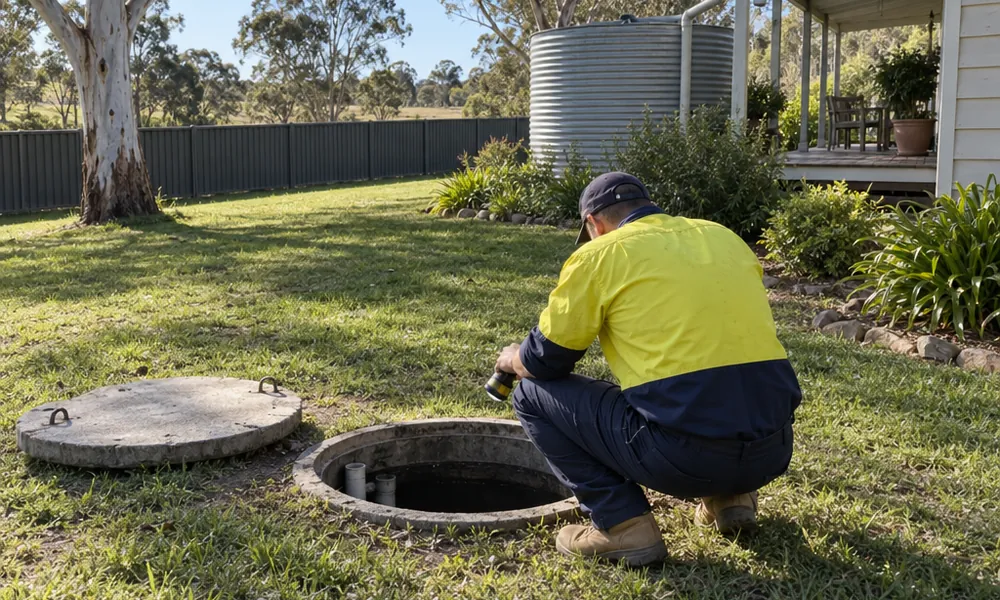
Illustration. A torch check at the open tank, with its lid set on the lawn.
In NSW, inspection comes with approval. Once a system is approved, OLG says council carries out regular inspections and can charge inspection fees.
How often is up to your council, and your approval conditions are the first place to look. Strategies like MidCoast's are written partly to steer that work. MidCoast says its strategy helps officers prioritise inspections.
Before an inspection, a little preparation helps:
- Know where the tank lids and the disposal area are.
- Keep the area clear.
- Have your service and pump-out records in one folder.
If you're not sure when the tank was last emptied, our pump-out guide explains what happens during and after one.
What to check if you own a septic system in NSW
Six checks for NSW septic owners
Sources: NSW Office of Local Government, business.gov.au, Together Cessnock, Cessnock City Council
New strategy or not, the same few checks keep you on the right side of your council:
- Find your council's pages. Open its septic or on-site sewage page and its fees and charges.
- Check your approval to operate. Confirm you hold one and note when it renews.
- Keep your records together. Every pump-out and service in one place.
- Aerated system? Keep its servicing up to date. If you're unsure which type you have, our page on primary and secondary treatment systems explains the difference.
- Cessnock owners: keep an eye on the project page for the final adopted strategy after the review stage.
- Use a licensed person for plumbing and drainage work.
Get the paperwork and the tank in step
Your council issues and renews your approval to operate, and Septic Tank Solutions is not the regulator. Councils do expect a tank to be operated, maintained and serviced, though, and that part lands with you between inspections.
If an inspection is coming, your approval asks for regular servicing, or you simply can't remember when the tank was last looked at, send Septic Tank Solutions the details of what your council has asked for through our contact page.
Sources
- Draft On-Site Sewage Management (OSSM) Strategy 2026-2031, Together Cessnock
- On-site Sewage Management Systems, Cessnock City Council
- Onsite Wastewater Management Strategy, Your Say Ballina
- Media release: Wastewater strategy adopted, MidCoast Council
- Water safety and management, NSW Office of Local Government
- Council Circular 25-05 Onsite Wastewater Management Guidelines, EIN Presswire
- Approval to operate an onsite sewage management system, Central Coast Council, Australian Business Licence and Information Service (business.gov.au)
Pictures in this guide are illustrations, not photos of our jobs.