 Septic Tank Solutions
Septic guides
Septic absorption trench rules in NSW and Queensland: who approves, sizes and protects your trench
In both NSW and Queensland your council approves a septic absorption trench, and its size and position come from a site and soil assessment and your council's conditions rather than a standard measurement: NSW issues separate approvals to install and to operate, while Queensland's permit application must include a system plan with the land application layout and a site and soil evaluation report, plus a Treatment Plant Approval copy for a secondary plant.
The short answer: your council and your soil decide the trench
| Question | NSW | Queensland |
|---|---|---|
| Who approves | your council, through an Approval to Install and an Approval to Operate under section 68 of the Local Government Act 1993Source: Northern Beaches Council, NSW Office of Local Government | your council, assessing under the Plumbing and Drainage Act 2018, the Queensland Plumbing and Wastewater Code (QPWC) and its permit conditions (as Southern Downs Regional Council explains it), with no installation without council approval (Business Queensland)Source: Southern Downs Regional Council, Business Queensland, on-site sewage |
| What you lodge | Central Coast Council exampleyou may need plans, specifications, site assessments and operation and maintenance details, often as part of a Development ApplicationSource: Central Coast Council listing (ABLIS) | Business Queensland: a plan showing the type, size and location of the system and the land application area layout, including the QPWC minimum setbacks; a site and soil evaluation report; a copy of the Treatment Plant Approval for a secondary treatment plant.Brisbane City Council, trenches added to an existing facilityForm 1, a site and soil evaluation and a site planSource: Business Queensland, supporting documents, Brisbane City Council |
| Who prepares or does the work | Central Coast Council exampleplumbing and drainage work only by licensed individualsSource: Central Coast Council listing (ABLIS) | supporting documents by a "competent person": a QBCC licensee whose licence qualifies them for the work, a registered professional engineer in a relevant speciality, or someone the local government considers competent.Source: Business Queensland, supporting documents |
| Example fee or timeframe | Central Coast Council$854.85 to install a domestic system, 2026-27 fee, further fees may apply (checked October 2026)Source: Central Coast Council listing (ABLIS) | Brisbane City Counciltrenches added to an existing facility assessed within 10 business days, clock pauses if more information is neededSource: Brisbane City Council |
| What sets the trench size | the AS/NZS 1547 soil-based loading rate (Table L1 covers trenches and beds) plus council rules. Queensland note: the QPWC is read with AS/NZS 1547:2012 (Southern Downs Regional Council).Source: AS/NZS 1547:2012 contents, Codehub, Southern Downs Regional Council | |
Source: Central Coast Council fees via ABLIS (checked October 2026)
Sources: Business Queensland, supporting documents, Business Queensland, on-site sewage
Put the two states' official pages side by side and one thing stands out: neither gives a homeowner a standard trench size. What each gives you is a sign-off process.
In NSW you need two council approvals, one to install the system and one to operate it. In Queensland, the supporting documents for a permit application with an on-site sewage facility must include a plan showing the system and the layout of the land application area with its setbacks, and a site and soil evaluation report, plus a copy of the Treatment Plant Approval if the system uses a secondary treatment plant.
So that is two approvals in one state and a set list of supporting documents in the other. The common thread is the soil. A trench's dimensions come from the soil-based design loading rate in AS/NZS 1547, where Table L1 recommends design loading rates for trenches and beds, and from your council's rules. That is why this page quotes no trench width or length. Yours is worked out for your block.
Our general guide, Understanding Absorption Trenches in Septic Systems, explains how a trench works. This page covers who approves one in each state, what you lodge and how to keep it working. For the standard behind it all, see AS/NZS 1547 Explained.
Who approves it in NSW?
In NSW, start to finish
Approval to Install (section 68, Local Government Act 1993)
council decides on a risk assessment and sets conditions
Installing or modifying a system needs both approvals.
Work done by licensed plumbers and drainers
Approval to Operate
the second council approval
Ongoing
the owner is responsible for the system being approved and working properly, and councils can charge inspection fees
Installing or modifying a system needs an Approval to Install and an Approval to Operate under section 68 of the Local Government Act 1993. Northern Beaches Council explains that council issues both on a risk assessment, and that the owner must comply with the conditions.
The responsibility then sits with you. The NSW Office of Local Government says the owner is responsible for the system being approved and working properly, and that councils can charge inspection fees.
What you lodge depends on your council. Central Coast Council's approval to install, construct or alter a system is listed on the federal ABLIS site. That listing places it under the Local Government Act 1993 and the Local Government (General) Regulation 2021. It also says:
- the approval is often granted as part of a Development Application;
- you may need plans, specifications, site assessments and operation and maintenance details;
- plumbing and drainage work can only be done by licensed individuals.
Central Coast Council application fees, 2026-27 (checked October 2026)
Central Coast Council only. Further fees may apply. Other councils set their own fees.
Source: Central Coast Council fees via ABLIS (checked October 2026)
Central Coast Council's 2026-27 fees are $854.85 to install a domestic system, $298.35 to alter an existing domestic facility and $1,193.35 to install a commercial system (checked October 2026), and further fees may apply. Treat those as one council's example. Your council sets its own.
Councils also update their local strategies. Cessnock City Council's Draft On-Site Sewage Management Strategy 2026-2031 went on public exhibition from 9 October to 6 November 2026. It was written to align with the Office of Local Government's On-site Wastewater Guidelines (2025). If your council has a new strategy, read its conditions before you plan trench work.
Who approves it in Queensland?
The Queensland permit pack
Permit application with an on-site sewage facility (Business Queensland)
- Plan: type, size and location of the system, and the land application area layout with QPWC minimum setbacks
- Site and soil evaluation report
- Copy of the Treatment Plant Approval (secondary treatment plant only)
Prepared by a competent person: QBCC licensee whose licence qualifies them for the work, registered professional engineer in a relevant speciality, or someone the local government considers competent
Septic-only (primary) system
no Treatment Plant Approval needed
Treatment plant
Treatment Plant Approval needed
no more than 4.2 kL a day: Housing and Public Works; 4.2 kL a day or more: Environment, Tourism, Science and Innovation (checked October 2026)
Brisbane City Council example
Trenches added to an existing facility: Form 1, site and soil evaluation, site plan; assessed within 10 business days, clock pauses if more information is needed.
Sources: Business Queensland, supporting documents, Business Queensland, on-site sewage, Brisbane City Council
Queensland works through a plumbing permit, and the state's line is simple: without council approval, the system can't be installed. A septic-only (primary) system does not need a Treatment Plant Approval, but a treatment plant does. Which department issues that approval depends on the plant's size. For a plant treating no more than 4.2 kL of sewage a day it is Housing and Public Works; for 4.2 kL a day or more, it is Environment, Tourism, Science and Innovation (checked October 2026).
Business Queensland lists what the application must carry:
- a plan showing the type, size and location of the system;
- the proposed land application area layout, including the minimum setback distances in the Queensland Plumbing and Wastewater Code (QPWC);
- a site and soil evaluation report, plus a copy of the Treatment Plant Approval if the system uses a secondary treatment plant.
Those documents must be prepared by a "competent person". That means a QBCC licensee whose licence qualifies them for the work, a registered professional engineer in a relevant speciality, or someone the local government considers competent.
Southern Downs Regional Council's page shows how a council applies this. It assesses on-site sewerage under the Plumbing and Drainage Act 2018, the QPWC and the council's development permit conditions. It also describes the QPWC as setting the technical requirements for site and soil evaluation, design, installation and operation, read with AS/NZS 1547:2012.
Brisbane City Council treats adding trenches as a job in its own right. "Installation of onsite sewage facility trenches to existing" is a separate application type. It needs Form 1, a site and soil evaluation and a site plan, and Brisbane assesses it within 10 business days. The clock pauses if council needs more information.
What stays the same in both states?
Looking after a trench, NSW or Queensland
Tick each one off as you go.
Cross the border and the paperwork changes, but the trench underground behaves the same way. Southern Downs Regional Council says septic tank (primary) effluent may go to trenches only. Secondary-quality treatment plants can also use surface or subsurface irrigation.
The same council's guidance says effluent must stay within the property boundary and that the owner is responsible for maintenance. Its don'ts are worth taping inside the laundry cupboard:
- don't let anyone park or drive over any part of the system;
- don't let roof or surface water enter the system;
- don't cover tanks with soil, mulch or pavers;
- don't make unauthorised alterations without council approval.
Planting matters as much as paperwork. Sunshine Coast Council advises shallow-rooted plants, grass or groundcovers, keeping the grass mown, and planting downstream of trenches. It warns that water-loving trees and shrubs can overgrow and clog pipes.
Our advice at Septic Tank Solutions is to treat the trench area as part of the system, not spare lawn. A trench works best on dry, level ground that gets sun and wind, with no cars and no downpipes feeding it.
Trench problems: what the signs mean and what to do
Why trenches fail (Sunshine Coast Council)
- 1solids carried over from the tank blocking soil pores
- 2tree roots blocking pipes and trench
- 3overgrown plants shading the area so sun and wind can't dry the soil
- 4a trench no longer level, overflowing at its low point
Hazards (Southern Downs Regional Council)
- Aa car wheel over the trench
- Ba roof downpipe and surface runoff heading for the system
Remedy (Northern Beaches Council)
- a low earth bank turning stormwater away from the absorption area
Soggy trench: check and cut water use. After heavy rain: divert stormwater. Water flowing from the trench: trenches may need replacing; desludging is only temporary.
Sunshine Coast Council lists four reasons trenches fail:
- solids carried over from the tank block the soil pores;
- tree roots block pipes and trenches;
- overgrown areas stop sun and wind drying the soil;
- trenches that are no longer level can overflow at any low point.
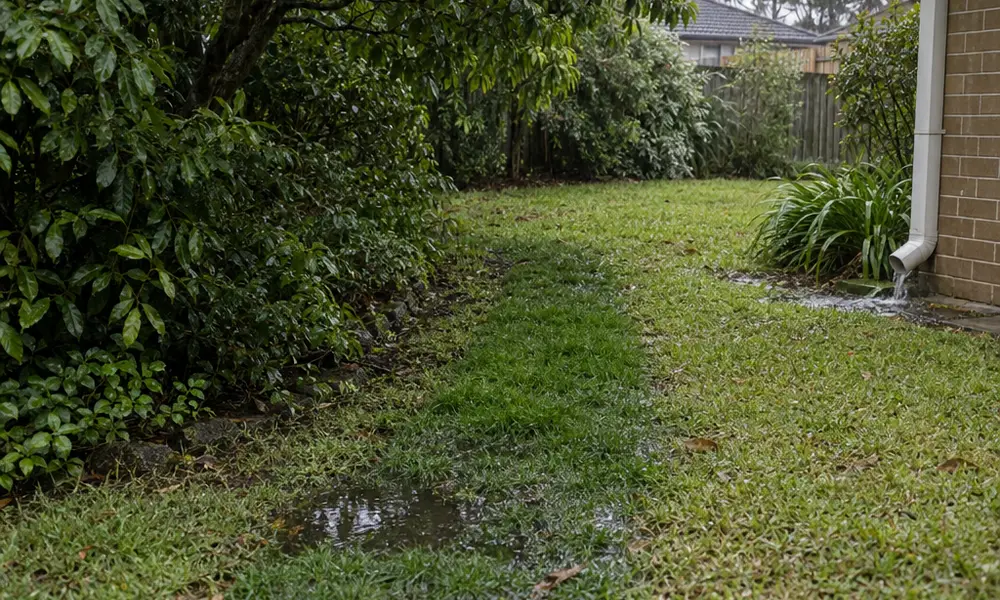
Illustration. A backyard after heavy rain, with a soggy, puddled strip of lawn.
Signs of failure include wet ground and smell. Northern Beaches Council's troubleshooting guide matches each sign to a first response:
- A wet or soggy trench, or surface water near it: check for increased water use and reduce it.
- Soggy ground after heavy rain: divert stormwater away from the absorption area with an earth bank. Our storm-season maintenance guide covers what else to check after a downpour.
- Water flowing from the trench: this is the serious one, because the trenches may need replacing.
Pumping out the tank does not fix a trench that has failed: when water is flowing from the absorption trench, desludging provides only a temporary solution.
Regular pump-outs still protect a healthy trench, because they limit the solids that reach the soil. Our pages on how often to empty a septic tank and the signs your tank needs pumping cover that side.
The warning signs also matter if you sell. Northern Beaches Council says owners selling or leasing must give the new owners or tenants an operating manual. That manual should cover signs of failure such as odours and surface ponding.
NSW and Queensland trench rules at a glance
NSW
- 2 council approvals: install, then operate (s68, Local Government Act 1993)
- Council decides on a risk assessment and sets conditions
- Example fee: Central Coast Council, $854.85 to install a domestic system, 2026-27, further fees may apply (checked October 2026)
Queensland
- Council approval before installation
- Required documents: a plan of the system and its land application area with QPWC setbacks, and a site and soil evaluation report; a secondary treatment plant adds a copy of its Treatment Plant Approval
- Prepared by a competent person
- Septic-only: no Treatment Plant Approval; treatment plant: approval needed
- Example timeframe: Brisbane City Council, 10 business days for trenches added to an existing facility, clock pauses for more information
Trench size: AS/NZS 1547 soil-based loading rate plus council rules. Failed trench: desludging is only a temporary solution.
Source: Central Coast Council fees via ABLIS (checked October 2026)
Sources: NSW Office of Local Government, Northern Beaches Council, Business Queensland, on-site sewage, Business Queensland, supporting documents, Brisbane City Council, AS/NZS 1547:2012 contents, Codehub
If you remember one thing per state, make it this. NSW needs two council approvals, and your council's conditions apply from day one. Queensland needs council approval before installation, backed by supporting documents, including a site and soil evaluation report, prepared by a competent person. In both states, your soil sets the size of the trench.
Your next step
Before anyone digs, find your council's approval and read its conditions. In NSW that means your Approval to Install and Approval to Operate. In Queensland it means your permit. Any new or extended trench should be designed from a site and soil evaluation by a qualified person.
If your trench is soggy, smells, or you are not sure what your approval allows, tell Septic Tank Solutions what you are seeing through our contact page. We will talk you through the next step for your block.
Sources
- https://www.olg.nsw.gov.au/public/laws-and-regulations
- https://www.northernbeaches.nsw.gov.au/community/safety-and-wellbeing/public-health/on-site-sewage-systems
- https://ablis.business.gov.au/service/nsw/approval-to-install-construct-or-alter-an-onsite-sewage-management-system-central-coast-council/9843
- https://together.cessnock.nsw.gov.au/draft-on-site-sewage-management-ossm-strategy-2026-2031
- https://www.business.qld.gov.au/industries/building-property-development/building-construction/plumbing-drainage/on-site-sewage
- https://www.business.qld.gov.au/industries/building-property-development/building-construction/plumbing-drainage/permits/supporting-documents
- https://www.sdrc.qld.gov.au/doing-business/planning-development/plumbing/on-site-sewerage-facilities-ossf
- https://www.brisbane.qld.gov.au/building-and-planning/application-process/plumbing-permit-applications/works-limited-to-sewerage-facilities
- https://www.sunshinecoast.qld.gov.au/land-application-areas
- https://codehub.building.govt.nz/resources/15472012asnzs
Pictures in this guide are illustrations, not photos of our jobs.