 Septic Tank Solutions
Septic guides
Septic tank pump out: how often, who can do it and what happens after
How often a septic tank needs pumping out depends on how many people use it, the tank's size and your approval conditions; in WA a licensed contractor must do the job, the Shire of Toodyay says contractors leave a little effluent in the tank so it doesn't float, and in WA and Victoria the waste must go to a site approved or authorised to take it.
Ask three official WA pages how often a two-person household should pump out its septic tank and you get three different answers. Healthy WA says every 8 years for a two-person household. WA Health's servicing page says every 4 years, or more often if the installation approval conditions say so. The Shire of Toodyay says pumped out every 3 to 5 years.
That is a gap of up to five years for the same house (our working: 8 years less 3).
The gap isn't an error. Each figure assumes a different household, tank and approval. Our advice at Septic Tank Solutions is to treat any rule of thumb as a starting point and to check your own approval conditions first.
The interval is also only half of a pump-out. This guide covers what changes the interval, who is allowed to do the job, and what is left in the tank once the truck drives away. For the household-size detail, see our guide on how often to empty a septic tank.
How often should a septic tank be pumped out?
Pump-out intervals in years
WA guidance. Your approval conditions can set a shorter interval.
Sources: Healthy WA, WA Health, Shire of Toodyay
Healthy WA says the frequency depends on how many people use the system. Its guide is every 8 years for two people, every 4 years for four, and more often for larger households.
WA Health sets every 4 years, or more often if the installation approval conditions say so. In WA, a shorter interval in your approval conditions is the one that counts.
The Shire of Toodyay adds a step many owners skip. It says a system should be inspected every 1 to 2 years and pumped out every 3 to 5 years, depending on tank size and the number of users.
Victoria's EPA gives no single figure. It says how often to de-sludge depends on many factors, including how much the system is used and the manufacturer's requirements.
These are WA and Victorian sources. We work on the Central Coast and in the Hunter, where your council's approval to operate sets the interval and the rules, so check yours first.
What makes a septic tank need pumping sooner?
The reason the interval matters is the soil, not the tank. Healthy WA explains that too much sludge and scum shrinks the tank's working volume, so solids and grease pass into the drainage receptacles and clog the surrounding soil.
What goes down the drain sets how fast that happens. The Victorian EPA's list of habits that help is short. Scrape fats and grease off dishes, put no solids in the system, avoid food waste disposal units unless the system can carry the load, and flush no hygiene products.
In WA, garbage grinders aren't permitted with septic systems without special authorisation.
Additives are not a substitute for pumping: as the Shire of Toodyay puts it, "No amount of additives will help a tank if what it really needs is to be pumped out."
Our septic tank dos and don'ts go further on day-to-day habits.
Signs your septic tank needs pumping, from least to most urgent
Check soon, then call now
Smelly system or backing-up toilet: often a sign the tank is overdue (Shire of Toodyay). Other sick-system clues: rotten-egg smell, mosquitoes near the tank or vents, soggy ground slow to dry.
Soggy ground or pooling wastewater over the drainage area; sewage overflowing from the grated gully outside; run-off from the disposal area: signs of failure, call a plumber or drainage contractor
The first rung is a tank that is probably overdue. The Shire of Toodyay says a smelly system or a backing-up toilet is often a sign the tank is overdue. Its other "sick system" clues are a rotten-egg smell, mosquitoes near the tank or vents (a sign of bad seals), and soggy ground that is slow to dry.
WA Health also says a slight odour is normal, but that is about aerobic and secondary treatment systems, not septic tanks, so don't read it as a green light for a smelly septic tank.
The top rung is the one to act on today. Healthy WA lists slow toilets or kitchen sink, sewage overflowing from the overflow relief disconnector gully, and soggy ground with effluent at the surface as signs of failure. Of the soggy ground it says it is unpleasant and a health risk, and it says to call a plumber or drainage contractor. The Victorian EPA's warning signs of failure add pooling wastewater on the absorption field, run-off from the disposal area, and a full or blocked grease trap.
If you see anything on that top rung, mention it when you book. A pump-out empties the tank, but the soil around the drains may need looking at too. Our page on signs your septic tank needs pumping has the fuller list.
Who is allowed to pump out a septic tank?
| What the guidance says | Where it applies | Source |
|---|---|---|
| A licensed contractor must pump out a septic tank | WA | WA Health |
| A licensed liquid waste contractor opens the tanks and pumps out the contents | WA | Healthy WA |
| Written permission from the local government is needed to dismantle, empty or remove a wastewater system, or change how it operates | WA | WA Health |
| Waste must go to an approved disposal or treatment site | Shire of Toodyay, WA | Toodyay |
| All reasonable steps must be taken so the waste goes to a lawful place authorised to receive it | Victoria | Vic EPA |
In WA, this isn't a job for a hired pump. WA Health says a licensed contractor must do it. Healthy WA describes the job as needing a licensed liquid waste contractor to open the tanks and pump out the contents.
WA Health's servicing page also says that without written permission from the local government, it is illegal to dismantle, empty or remove a wastewater system, or to change how it operates. If you're unsure whether your job needs that permission, ask your council's Environmental Health Officer before you book.
Where the waste ends up is covered too. In Victoria, all reasonable steps must be taken to make sure the waste goes to a lawful place that is authorised to receive it. The Shire of Toodyay says the waste must go to an approved disposal or treatment site.
Getting the tank ready before the truck arrives
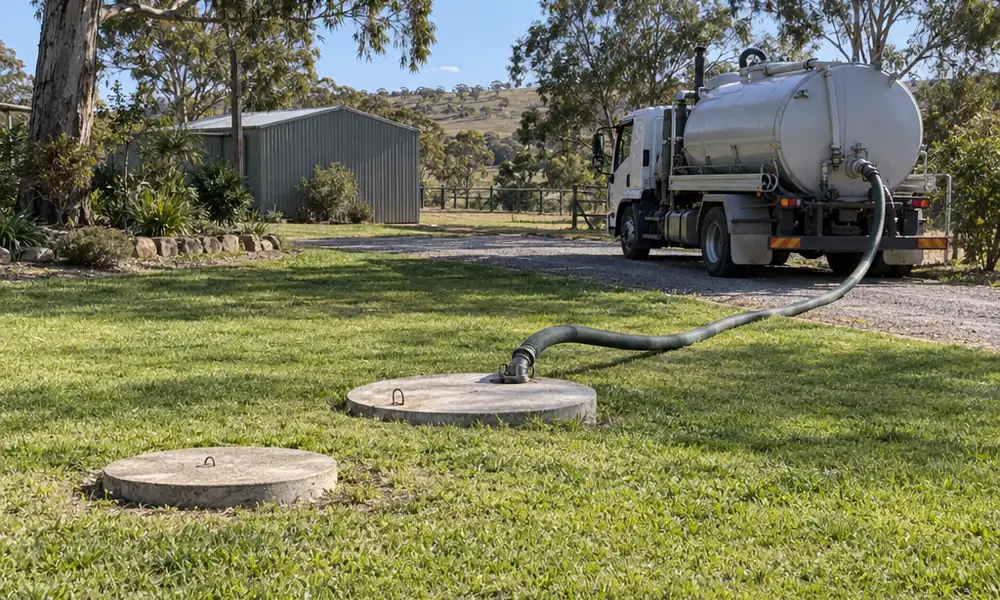
Illustration. Tank lids cleared and easy to reach, with the tanker parked on the driveway.
Before the visit
The contractor needs to reach the lids. The Victorian EPA says to keep the system easy to access for maintenance, and not to drive over it or cover the tank or drain field. Healthy WA also says don't drive vehicles over the system.
Before the visit, clear pot plants, mulch and outdoor furniture off the lids. Agree with the driver where the truck will park so it stays off the trench. Jot down when the tank was last pumped out and any signs you've noticed.
What happens to the tank after a pump-out?
The path a pump-out takes
The pump-out
After the pump-out
Sources: Shire of Toodyay, Healthy WA, Vic EPA
Don't expect an empty tank when you lift the lid. The Shire of Toodyay says contractors leave a small volume of effluent in the tank so it doesn't float. It also says bacteria levels recover once wastewater flows in again, so you can go back to normal use.
The truck then takes the waste to an approved or authorised site, as the section above sets out.
If your system has alternating drains, Healthy WA says they should be switched annually. A pump-out visit is a handy reminder to ask about it.
Why keep the pump-out receipt?
The receipt is your maintenance record. In Victoria, owners must keep maintenance records and give them to council when requested. The same page says owners must tell council if the system poses a risk or has a problem. If someone else reports smells to council when you haven't, that can attract a penalty.
Cardinia Shire's wastewater plan FAQ puts it plainly: proper maintenance is a legal requirement under the Environment Protection Act 2017.
File each receipt with the date and a note of anything the contractor found. Your next pump-out date is then easy to work out, and the paperwork is ready if council asks for it.
Checking the tank after heavy rain
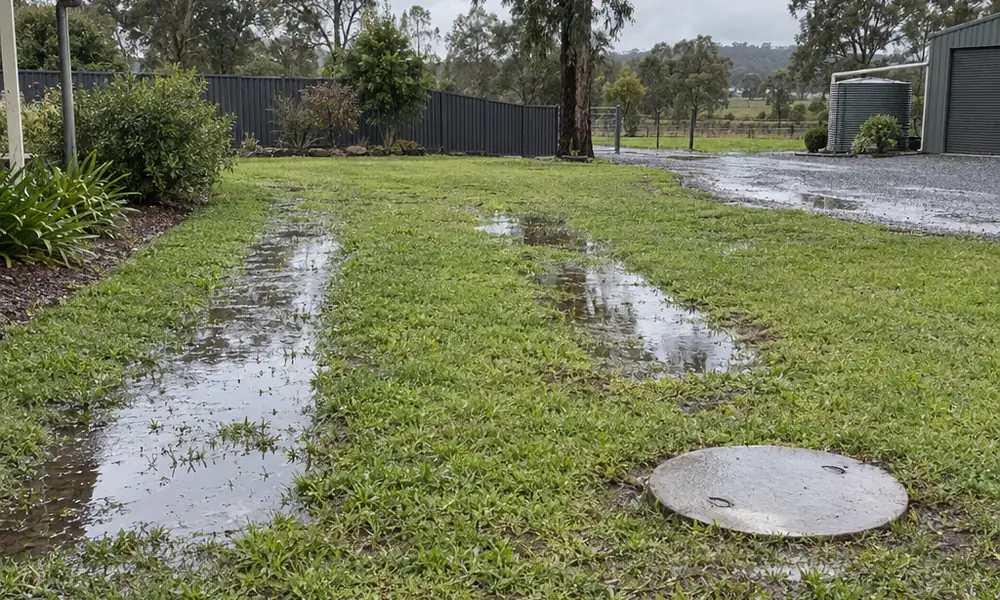
Illustration. Strips of puddles over the lawn after heavy rain, near the tank lid.
Rain can fill a tank as fast as a household can. The Shire of Toodyay says to check the tank's wastewater level after very heavy rain, because a dramatic rise may mean stormwater is getting in. The Victorian EPA says don't direct stormwater into it.
This season makes that check worth doing. The Bureau of Meteorology's long-range forecast for November 2026 to January 2027 points to above-average rainfall for parts of western, central and eastern Australia.
Our storm-season maintenance guide covers what to check before and during wet weather. If water has already been over the yard, start with what to do after the water goes down.
Is it a septic tank or an aerobic treatment unit?
Four-year timeline
Aerobic treatment unit (WA)
a service mark every 3 months
Septic tank (WA Health)
every 4 years, or more often if approval conditions say so
Sources: Shire of Toodyay, WA Health
Everything above is about septic tanks. The Shire of Toodyay notes that an aerobic treatment unit (ATU) looks like a septic system but is a different system, and in WA it must be serviced every 3 months.
That is 16 services in the four years WA Health gives as a septic tank's pump-out interval. This is our estimate: 4 services a year, multiplied by 4 years. If you have an ATU, follow its servicing schedule, not a septic pump-out interval. Our page on primary and secondary treatment systems can help you work out which one you have.
Septic pump-out at a glance
How often (WA guidance)
- 2-person household, every 8 years (Healthy WA)
- 4-person household, every 4 years, more often for larger households (Healthy WA)
- septic tank, every 4 years or more often if approval conditions say so (WA Health)
- inspect every 1 to 2 years, pump out every 3 to 5 years (Shire of Toodyay)
- aerobic treatment unit, serviced every 3 months (WA, Shire of Toodyay)
The pump-out itself
- licensed contractor (WA, WA Health)
- written permission from local government to dismantle, empty, remove or change a system (WA, WA Health)
- small volume of effluent left in the tank (Shire of Toodyay)
- waste to an approved or authorised site (Shire of Toodyay; Vic EPA)
- keep records for council (Vic EPA)
Every interval and rule in this guide, with who sets it.
Ready to book a pump-out?
Your tank may be due on the calendar, your approval conditions may call for a pump-out, or you may have spotted one of the signs above. Whichever it is, contact Septic Tank Solutions through our contact page.
Tell us how many people use the system and when it was last pumped out. Let us know too if you've seen soggy ground or an overflowing gully, so the visit starts with the full picture.
Sources
- https://www.health.wa.gov.au/Articles/S_T/Servicing-wastewater-systems
- https://www.healthywa.wa.gov.au/Articles/U_Z/Understanding-Septic-Tank-Systems
- https://www.toodyay.wa.gov.au/resident-services/public-health/effluent-disposal/wastewater-maintenance.aspx
- https://www.epa.vic.gov.au/manage-onsite-wastewater-management-system
- https://creating.cardinia.vic.gov.au/onsite-wastewater-management-plan-owmp
- https://www.bom.gov.au/video/long-range-forecast-november-2026-to-january-2027
Pictures in this guide are illustrations, not photos of our jobs.